
The Color of Law

Updated: Oct 31, 2021
Redlining... origins of a national policy born from the New Deal were used by all levels of government to promote segregation of entire communities. In 2017, Richard Rothstein published his book, The Color of Law, which focused on several cases of governmental policy that promoted and expanded these discriminatory policies.
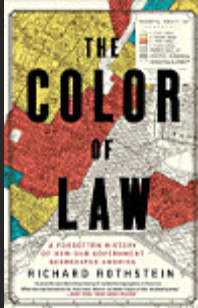
In May 2017, NPR interviewed Rothstein on his new book... (link here for source page and transcript).
Eventually, I was able to get my hands on this book (and as I do when I've referred to a book often enough, it was worth purchasing my own copy). While the book focuses on post-FHA policy, I found myself going back often enough to thoughts of my own community. There's a lot to be said positive about Berkeley, and the reputation it has as a forward-thinking, liberal enclave isn't completely unfounded, (yes the Free Speech Movement happened here... but there were reasons why folks felt the need.)
What many don't know is that Berkeley was a place started by a minister... named for a bishop and philosopher (Berkeley) and for the first several years of its existence, run by Workingmen's Party (think Denis Kearney and the sandlot rallies, and "the Chinese Must Go!"), and later, a socialist Mayor... Perhaps this last bit makes sense for those that aren't from Berkeley or tend to believe it is this bastion of hippie-dom. The idea of Berkeley as a "Hippie" zone was the first thing I disavowed myself of when I moved here in March of 2000. Sure there's some 'granola' eating folks here, but you could say that about most anywhere these days. Berkeley is a lot of things, and often enough, it was a place of discrimination.
So yes, as I learn about California history and Berkeley in particular, I found myself thinking back to that article about George Shima's house. When reading Yoshiko Uchida's Desert Exile, I again thought about George Shima. Reading The Color of Law, something became clear as well. These state and federal policies came from somewhere. Even Rothstein points out a source of some of these policies in Berkeley. The more I looked into it, the more complicated it became.
As it came time to think of possible topics for my MA thesis, I recalled how Rothstein talked about how de-jure and de-facto segregation are often indistinguishable. "Where private discrimination is pervasive, they argue, discrimination by public policy is indistinguishable from 'social discrimination"(1). While Rothstein focuses on the discrimination of African Americans, California (and Berkeley) discriminated against many, many more groups of people. The fact that George Shima was "allowed" to purchase a home east of Shattuck Avenue (Berkeley's "Main Street") does not negate the words and deeds of many individuals that would petition to make it harder for individuals to make a home for themselves in the state where they lived and labored. In fact, I wanted to find out if Rothstein was right. Were cities like Berkeley or Oakland a source of the racism at the individual and municipal level which t Roosevelt and his policymakers sourced FHA policy??
(1) Richard Rothstein, The Color of Law : a Forgotten History of How Our Government Segregated America (New York : Liveright Publishing Corporation, a division of W.W. Norton & Company, 2017) xiv-xv.



Comments